Last reviewed: 30 July 2026. Customers encounter several names around the same hosting ecosystem: Advika Enterprises, Advika Cloud, Advika Web Developments Hosting Pvt Ltd, Advika Data Center Services Pvt Ltd and StreamData Networks. The names do not all describe the same layer. This guide maps the roles visible in public websites, network registries and partner material and explains which name a buyer should expect at each stage.
Scope warning: This is an operating and brand map, not a definitive corporate-ownership chart. Public evidence supports the relationships described below, but the legal parent, shareholding and inter-company contracting structure should be confirmed from corporate records and the customer agreement.
The ecosystem in one view
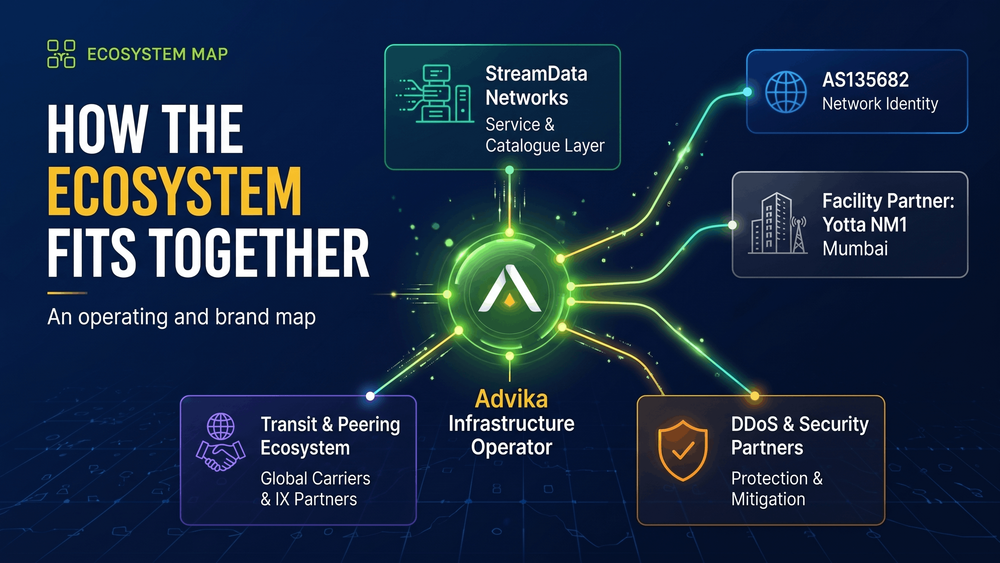
| Name | Primary role visible publicly | Evidence |
|---|---|---|
| Advika Enterprises / Advika Cloud | Marketing umbrella for cloud, VPS, dedicated and custom infrastructure services. | Advika website branding and service pages. |
| Advika Web Developments Hosting Pvt Ltd | Registered network organization for AS135682. | APNIC and public BGP records. |
| Advika Data Center Services Pvt Ltd | Hosting and infrastructure operator named in StormWall’s 2026 case study. | StormWall customer case study. |
| StreamData Networks | Customer-facing product catalogue, blog and hosting order path. | StreamData website and Advika “Manage Hosting” link. |
| Yotta Data Centre | Facility partner; holder of the facility certificates linked by Advika. | Advika certificate disclosure and linked documents. |
| Cloudflare, Tata Communications, Airtel and other networks | Transit, interconnection or security ecosystem around AS135682. | BGP visibility, Advika partner display and network records. |
| StormWall | BGP-based DDoS mitigation provider documented for an Advika deployment. | StormWall case study. |
| Technology and hardware vendors | Control-panel, software and hardware ecosystem used to build services. | Advika partner page; exact use varies by product. |
Advika Enterprises and Advika Cloud: the umbrella brand
The current Advika website uses “Advika Enterprises” and “Advika Cloud” as customer-facing names. It presents cloud VPS, high-frequency VPS, dedicated servers, private cloud, GPU servers and custom infrastructure. It also publishes support, uptime and reach statements and displays a broad partner ecosystem.
For a buyer, this is the brand and service-description layer. It explains the portfolio and operating philosophy, but the brand name alone does not identify which company will invoice the service or which ASN will carry a server.
Advika Web Developments Hosting Pvt Ltd: the ASN holder
Public APNIC and BGP records associate Advika Web Developments Hosting Pvt Ltd with AS135682. This is the strongest public answer to the question “who operates the routing domain?” The ASN originates IPv4 routes and is observed with multiple upstream and peer relationships.
The ASN holder matters for route policy, IP reputation, abuse coordination, RPKI and external connectivity. It does not automatically identify the facility owner or contracting entity for every product.
Advika Data Center Services Pvt Ltd: the operator named by StormWall
A separate StormWall case study names Advika Data Center Services Pvt Ltd as an Indian hosting and infrastructure provider. It describes VPS, dedicated servers, colocation, cloud and enterprise network services across Jaipur, Noida and Mumbai and documents a BGP-integrated DDoS protection deployment.
The use of a different Advika legal name is not inherently unusual; operating groups can use multiple companies. It does, however, make contract clarity essential. A customer should know whether network operation, hardware, billing and support are provided by one entity or allocated among affiliates.
StreamData Networks: the product and order layer
StreamData Networks presents the clearest self-service product catalogue in the ecosystem. It lists VPS and dedicated configurations, publishes infrastructure guides and routes customers into the hosting-management environment. Advika’s current website links its “Manage Hosting” navigation directly to StreamData.
Operationally, this makes StreamData the storefront and content layer through which customers discover, compare and order infrastructure backed by the wider Advika network and partner stack. Buyers should still check the invoice and contract because a brand URL is not the same thing as a legal counterparty.
Yotta: the facility layer
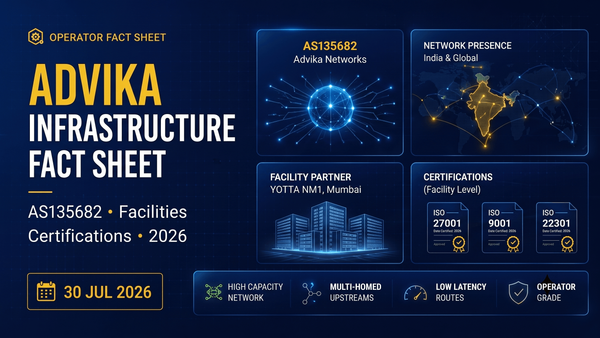
Advika states that its infrastructure runs from Yotta Data Centre. The ISO and MeitY documents linked on Advika’s website name Yotta entities as the holders. This means the certificates provide assurance about the named Yotta management systems, facilities and service scope; they are not certificates issued to StreamData or Advika.
A facility partnership can cover power, cooling, physical security, environmental controls, remote hands and cross-connects. The exact allocation of responsibility should appear in Advika’s supplier agreements and, where relevant, the customer SLA.
Network and security partners
AS135682’s public routing view currently shows direct upstream relationships involving Cloudflare, Tata Communications and Bharti Airtel. Advika also displays other carrier and internet-partner logos. A logo can reflect a technology, network or commercial relationship, but buyers should not infer that every logo represents direct transit on every product.
Advika’s marketing describes Cloudflare-powered DDoS protection. StormWall independently documents a BGP mitigation deployment. These can coexist: networks frequently use different security paths, products or vendors for different prefixes, attack types, locations or customer requirements. The order should name the protection scope for the service being purchased.
Technology and hardware brands
Advika displays control-panel and software vendors such as cPanel, Plesk, Virtualizor, Webuzo, Softaculous, Imunify and SolidCP, along with hardware brands including AMD, Intel, ASUS, Synology, HPE and Lenovo. These logos indicate an ecosystem, not a guarantee that every server includes every product. Licensing, hardware model and support entitlement should be listed per plan.
How a customer transaction should flow
- Discovery: the customer reads Advika or StreamData service information and selects a workload model.
- Technical validation: sales confirms city, facility, ASN, CPU, memory, storage, network, protection and backup scope.
- Commercial offer: the quotation names the invoicing and contracting entity and incorporates the SLA and policies.
- Provisioning: the service is deployed on the specified hardware or virtual platform and assigned IP space from the disclosed network.
- Operations: StreamData/Advika support coordinates software, hardware, network and facility dependencies.
- Incident response: the customer opens one ticket; the operator escalates internally to network, security, facility or hardware partners without making the customer chase suppliers.
- Renewal or exit: the customer receives notice, data-export options, cancellation terms and a secure deletion process.
Which name should appear where?
| Document or system | Name you should verify |
|---|---|
| Website and product page | The trading brand, plus a link to legal terms. |
| Quotation and invoice | The legal entity accepting payment and tax responsibility. |
| SLA | The entity responsible for the service commitment and credits. |
| IP/ASN record | The routing organization or disclosed upstream. |
| Certificate | The actual certificate holder and named site. |
| Data-processing terms | The entity processing customer and end-user data. |
| Abuse contact | The network or hosting entity able to investigate the assigned IP. |
| Support ticket | A single accountable operator even when partners are involved. |
Questions partners and resellers should ask
- Which entity owns the end-customer relationship?
- Can the service be white-labelled, and which infrastructure claims may be repeated?
- Which brand handles abuse, security incidents and legal requests?
- Can a partner advertise Yotta certificates, and what wording is approved?
- Which ASN and reverse-DNS model apply to partner services?
- Who supplies DDoS reports, uptime evidence and incident communications?
- Are product prices, support levels and renewal terms consistent across Advika and StreamData channels?
- What happens to customers if a brand or billing platform changes?
What should be standardized across the group
- A public legal-entity and brand-disclosure page.
- One current certificate register with holder, scope, site, issue date and expiry.
- A network-transparency page for AS135682 with prefixes, exchanges, RPKI and test endpoints.
- Consistent product naming and technical scope across Advika and StreamData.
- One incident and maintenance communication policy.
- Clear wording distinguishing facility, network, hardware and brand ownership.
- A current subprocessor and infrastructure-partner list for compliance buyers.
Bottom line
The public evidence supports a coherent operating model: Advika is the broader infrastructure and network ecosystem; AS135682 is registered to Advika Web Developments Hosting Pvt Ltd; Advika Data Center Services Pvt Ltd appears as the operator in StormWall’s case study; StreamData Networks is the customer-facing product and ordering brand; Yotta supplies the facility layer; and carriers, security vendors, software platforms and hardware manufacturers support specific technical functions.
The remaining work is legal and documentary precision. Customers should receive one clear statement of which entity contracts, which network and facility serve the order, which partner claims apply, and which documents are current. That clarity makes a multi-brand, partner-led infrastructure model easier—not harder—to trust.
For the dated technical record, see Advika Datacenter Services: 2026 Fact Sheet.