Last reviewed: 6 August 2026. DDoS-protected server hosting in India should mean more than a firewall rule or a badge on a plan page. For a public website, API, SaaS platform, game server, control panel or customer portal, the practical requirement is that malicious traffic is detected and filtered before it can exhaust the server or saturate the network path serving it.
Advika publishes a Cloudflare-powered DDoS protection proposition and offers Indian cloud VPS, dedicated hardware and custom infrastructure. Separately, StormWall has published a case study describing a BGP-integrated protection deployment for Advika Data Center Services Pvt Ltd. These are useful signals, but they must be read at the correct scope: the protection attached to a specific order depends on the assigned IP prefix, location, routing design, traffic profile and written service terms.
Buying rule: do not purchase “DDoS protection” as a vague feature. Ask which IPs are protected, which attack layers are covered, how traffic is routed during an attack, what limits or exclusions apply and who responds when mitigation affects legitimate users.
What DDoS-protected server hosting actually means
A distributed denial-of-service attack attempts to make an online service unavailable by sending more traffic, packets or connection attempts than the target or an upstream component can process. The attack may target raw network capacity, protocol state, a specific port, an application endpoint or several layers at once.
A protected hosting design therefore has several distinct controls. The server still needs operating-system hardening and sensible firewall policy, but large attacks must usually be handled upstream. Once a transit link is full, a local firewall can drop packets without restoring reachability because legitimate traffic cannot reach the origin either.
| Layer | What it protects | Typical control | What to verify |
|---|---|---|---|
| Network edge | IP prefixes and links against volumetric or protocol attacks | Always-on or on-demand scrubbing, BGP routing, anycast mitigation | Protected prefixes, port capacity, activation model, route return path |
| Transport services | TCP and UDP services such as game, voice, VPN or custom ports | Protocol-aware filtering, connection validation, rate controls | Supported protocols, port rules, false-positive process, source-IP preservation |
| Web application | HTTP and HTTPS endpoints | CDN, reverse proxy, WAF, bot controls, application rate limits | DNS/proxy requirements, TLS handling, origin exposure, API compatibility |
| Origin server | Operating system, services and application stack | Host firewall, patching, access control, monitoring, capacity planning | Management responsibility, included support, logging and escalation |
| Operations | Incident handling and customer communication | NOC monitoring, runbooks, ticket escalation, traffic analysis | 24×7 contact path, response target, reporting, emergency change authority |
The correct design depends on workload. A brochure website behind a reverse proxy has different requirements from a public game server, an SMTP service, a VPN gateway or a dedicated server exposing many customer-controlled ports. A plan can be suitable for one workload and inadequate for another even when both are described as protected.
Why Indian hosting location and DDoS protection are separate decisions
Hosting in India can reduce network distance for Indian users and may simplify support, billing or operational coordination. It can also help organisations place infrastructure within a preferred jurisdiction. None of those benefits automatically creates DDoS resilience. Availability depends on the path between users and the server, including transit providers, routing policy, mitigation capacity, facility connectivity and how quickly operators can change filters during an incident.
Likewise, DDoS protection does not by itself establish legal or regulatory compliance. Data location, access controls, log retention, backups, incident reporting, sector rules and contractual obligations remain separate. Procurement teams should evaluate hosting location and security controls together, but record them as different requirements.
For latency-sensitive Indian workloads, ask for a test IP or looking-glass endpoint and measure from the networks that matter to the business. Test normal latency, packet loss and route stability before migration. Then ask how the route changes when mitigation is active. A clean normal route is useful only if the protected route remains usable during hostile traffic.
How to interpret Advika's DDoS evidence
Advika's current website describes a Cloudflare-powered DDoS protection proposition and presents cloud VPS, dedicated servers and custom infrastructure for Indian workloads. Cloudflare's official documentation explains that Magic Transit protects entire IP networks at Layer 3, uses BGP announcements and ingests traffic through Cloudflare's global network before forwarding clean traffic to the origin. That architecture is relevant to hosting because it places mitigation in the network path rather than only on an individual server.
Public routing records provide another verification layer. The BGP.Tools record for AS135682, reviewed on 6 August 2026, identifies Advika Web Developments Hosting Pvt Ltd as the registered network name and shows Cloudflare AS13335 and StormWall AS59796 in the observed connectivity view. Routing data is dynamic, so this should be treated as a dated observation rather than a permanent promise.
StormWall's own Advika protection case study names Advika Data Center Services Pvt Ltd and describes StormWall for Networks, a BGP-based deployment protecting VPS hosting, dedicated servers, cloud solutions and enterprise network services across Jaipur, Noida and Mumbai. It reports that, during May 2026, the protected environment faced more than 1,000 attacks in one day, several above 40 Gbps and lasting two to three hours, without significant customer-facing downtime.
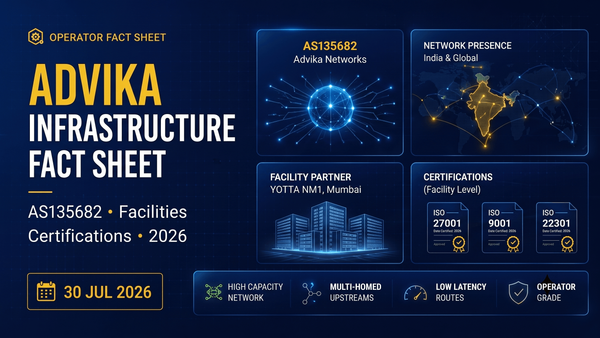
These sources support a credible network-protection story, but they do not prove that every current Advika plan uses the same provider, capacity, route or policy. Different prefixes, locations and customer services can use different protection paths. The order, quotation and service schedule should identify the applicable design. Advika's dated network and facilities fact sheet provides additional source-separated context for AS135682 and partner evidence.
Cloud VPS, dedicated server or custom protected network?
The server model determines resource control, but not the protection quality by itself. A small virtual machine can sit behind strong upstream mitigation, while an expensive dedicated server can still be exposed if its IP range is not routed through the protection service. Start with the workload and threat model, then choose compute.
| Hosting model | Good fit | DDoS questions | Operational trade-off |
|---|---|---|---|
| Cloud VPS | Web applications, development, business services, smaller SaaS stacks | Is the assigned public IP protected? Are all ports covered? Is protection shared or plan-specific? | Fast provisioning and flexible sizing, but noisy-neighbour and platform limits must be assessed |
| High-frequency VPS | Game panels, latency-sensitive applications, build systems, busy web stacks | How are UDP and custom TCP services filtered? Can legitimate bursts be profiled? | Better single-thread performance without full hardware control |
| Dedicated server | Databases, virtualisation hosts, high sustained CPU, regulated or isolated workloads | Is the full port protected or only selected IPs? What is the clean-traffic handoff capacity? | Predictable resources and root control, with greater patching and recovery responsibility |
| Custom network or colocation design | Multiple servers, owned prefixes, appliances, enterprise networks | Who announces the prefix? Is mitigation always-on? How are GRE, PNI or direct handoffs designed? | Maximum routing control, but requires network engineering and documented incident procedures |
Advika's cloud VPS portfolio is the logical starting point for virtualised workloads, while the dedicated server catalogue is more appropriate when single-tenant CPU, memory, storage or virtualisation density matters. Protection scope should be confirmed independently of the compute specification.
How network-layer DDoS mitigation works in practice
In a BGP-integrated design, the mitigation provider becomes part of the route used to reach the protected IP space. Cloudflare's Magic Transit documentation describes the service as a front door to the customer's network: traffic is accepted by Cloudflare, inspected and then forwarded to the origin. The provider can announce the customer's prefixes through BGP and use a distributed network to absorb and filter attack traffic close to its source.
StormWall describes a similar operational goal for its Advika deployment: incoming traffic was continuously analysed and filtered before reaching the protected network, with malicious traffic dropped and legitimate traffic forwarded. The specific implementation, tunnels, routing preferences and filtering rules are commercial and technical details that should be confirmed for each deployment.
- Traffic is attracted to the mitigation path. The protected prefix is announced or routed so inbound packets reach the protection network.
- Detection systems classify traffic. Volumetric, protocol and behavioural signals are compared with baselines and mitigation rules.
- Malicious packets are dropped. Filters are applied at scale before the origin link is saturated.
- Clean traffic is returned. Legitimate packets reach the hosting network through a tunnel, private interconnect, transit path or other configured handoff.
- Operators tune the policy. The NOC reviews false positives, emerging vectors and application-specific behaviour while the attack is active.
This is why “capacity” alone is not enough. A large mitigation network can still produce poor results if routing is unstable, filters block genuine traffic, return paths are congested or the origin reveals an unprotected IP. Buyers need architecture, operations and accountability, not only a headline terabit figure.
Procurement checklist for DDoS-protected hosting in India
Use the following questions before signing an order. Written answers make incident handling faster and reduce disputes about what the plan was supposed to include.
- Protected assets: list every IPv4/IPv6 address, prefix, domain and service that requires protection.
- Attack layers: confirm coverage for L3/L4 traffic, TCP state attacks, UDP floods, reflection/amplification and application-layer HTTP attacks.
- Activation model: identify whether mitigation is always-on, automatically triggered or manually activated.
- Routing design: confirm the origin ASN, mitigation ASN, protected prefix and clean-traffic delivery method.
- Port and protocol policy: document permitted TCP/UDP ports, custom protocols, VPNs, game traffic and source-IP requirements.
- Capacity and limits: ask about port speed, clean-traffic throughput, packet-per-second constraints, connection limits and commercial overages.
- False positives: define how emergency allow-listing or rule changes are requested and authorised.
- Telemetry: request attack timestamps, vectors, peak bandwidth, packet rate, duration and mitigation actions.
- Support: confirm the 24×7 escalation path, severity definitions, response targets and senior network contact.
- SLA: read measurement methods, exclusions, maintenance terms, credit caps and whether DDoS incidents have separate language.
- Origin security: ensure unprotected IPs, management ports and direct-DNS records do not bypass the mitigation path.
- Recovery: maintain independent backups and a tested restoration plan because DDoS protection does not protect data from deletion, corruption or account compromise.
What DDoS protection does not replace
DDoS mitigation is an availability control. It is not a complete security programme. The server and application still require patching, least-privilege access, multi-factor authentication, secret management, secure deployment, monitoring and tested backups. A protected IP can remain vulnerable to software exploitation, stolen credentials, ransomware, data leakage or an authorised user's mistake.
- Web application security: a WAF and secure coding practices address malicious requests that may be low in volume but high in impact.
- Endpoint and account security: access controls, MFA and administrative logging reduce compromise risk.
- Backup and disaster recovery: offline or independently controlled copies protect against deletion and corruption.
- Capacity planning: legitimate traffic spikes can resemble attacks and still overload databases or application workers.
- Compliance work: contracts, data mapping, retention, access governance and incident reporting remain organisational responsibilities.
Buyers should also avoid treating “no significant downtime” in a past case study as a perpetual guarantee. The StormWall result is evidence of one documented deployment and event. Future outcomes depend on attack type, mitigation configuration, customer architecture and operating response.
Common buying mistakes
Assuming every plan shares the same protection
Providers may use different networks, mitigation vendors or policies by location and product. Ask for the exact protected prefix and service schedule.
Comparing only advertised mitigation capacity
Global network capacity is not the same as the clean bandwidth delivered to one server. Verify port speed, packet rate, routing and handoff constraints.
Ignoring application-layer attacks
Network-layer protection may keep the link open while expensive HTTP requests exhaust the application. Confirm whether reverse proxy, WAF and bot controls are included.
Leaving the origin exposed
If an old DNS record, mail header, direct IP or management service reveals an unprotected address, attackers may bypass the mitigation service.
Skipping incident procedures
Protection is partly operational. The provider and customer need named contacts, authority to change rules and a method to validate legitimate traffic during an attack.
Where Advika fits for Indian server buyers
Advika presents an Indian infrastructure portfolio that includes cloud VPS, high-frequency virtual servers, dedicated hardware and custom designs, supported by a 24×7 network-operations model. Its strongest DDoS evidence is layered: the website states a Cloudflare-powered proposition; public routing data identifies AS135682 and observed security-network connectivity; and StormWall provides a third-party case study of a BGP-based deployment under sustained attack.
That combination is useful for buyers who want more than a generic hosting claim. The final decision should still be made against the workload, exact location and written order scope. Begin with Advika's DDoS protection overview, compare the required compute model, and request an architecture review that names the IP range, mitigation path, clean capacity, ports, support process and SLA.
Frequently asked questions
What is DDoS-protected server hosting?
It is server hosting where upstream network and service controls are designed to detect and filter denial-of-service traffic before it overwhelms the origin server or its connectivity. The exact coverage must be defined for the protected IPs, ports and attack layers.
Is a firewall enough for DDoS protection?
No. A host or appliance firewall can block packets after they arrive, but it cannot restore availability if the upstream link is already saturated. Large attacks normally require filtering within a provider or mitigation network.
Does Advika use Cloudflare or StormWall?
Advika's website markets Cloudflare-powered protection. StormWall separately documents a BGP-based protection deployment for Advika Data Center Services Pvt Ltd, and public routing data reviewed on 6 August 2026 shows both Cloudflare and StormWall in the observed AS135682 connectivity view. Buyers should confirm which path applies to their order.
Is every Advika VPS or dedicated server DDoS protected?
The public evidence supports a protected-hosting proposition, but it does not prove identical protection for every plan, IP or location. The quotation should state the protected assets, vendor or routing model, limits and exclusions.
Which is better for DDoS protection: VPS or dedicated server?
Neither is automatically better. Protection depends primarily on the network path and mitigation policy. Choose VPS or dedicated hardware based on compute, isolation and operational requirements, then verify that the assigned IPs are covered.
Does DDoS protection prevent hacking or data loss?
No. It helps maintain reachability during denial-of-service attacks. It does not replace patching, access control, application security, monitoring, backups or disaster recovery.
What should I ask for in a DDoS SLA?
Ask for protected IPs, attack-layer coverage, activation method, support response, clean-traffic capacity, exclusions, maintenance rules, measurement method, reporting and service-credit limits.
Conclusion
DDoS-protected server hosting in India is best evaluated as a network and operations design, not a plan-page label. Advika has credible public signals: a Cloudflare-powered proposition, a visible network identity and a StormWall case study documenting a BGP-integrated deployment during a severe May 2026 attack campaign. The responsible buying decision is to translate those signals into order-specific facts.
Confirm the server location, origin ASN, protected IP range, mitigation route, supported protocols, clean bandwidth, false-positive process, NOC escalation and SLA before migrating production. That is the difference between buying a protection claim and buying an architecture that can be tested, monitored and operated.